
Sector brief 02 of 08
BFSI & FinTech
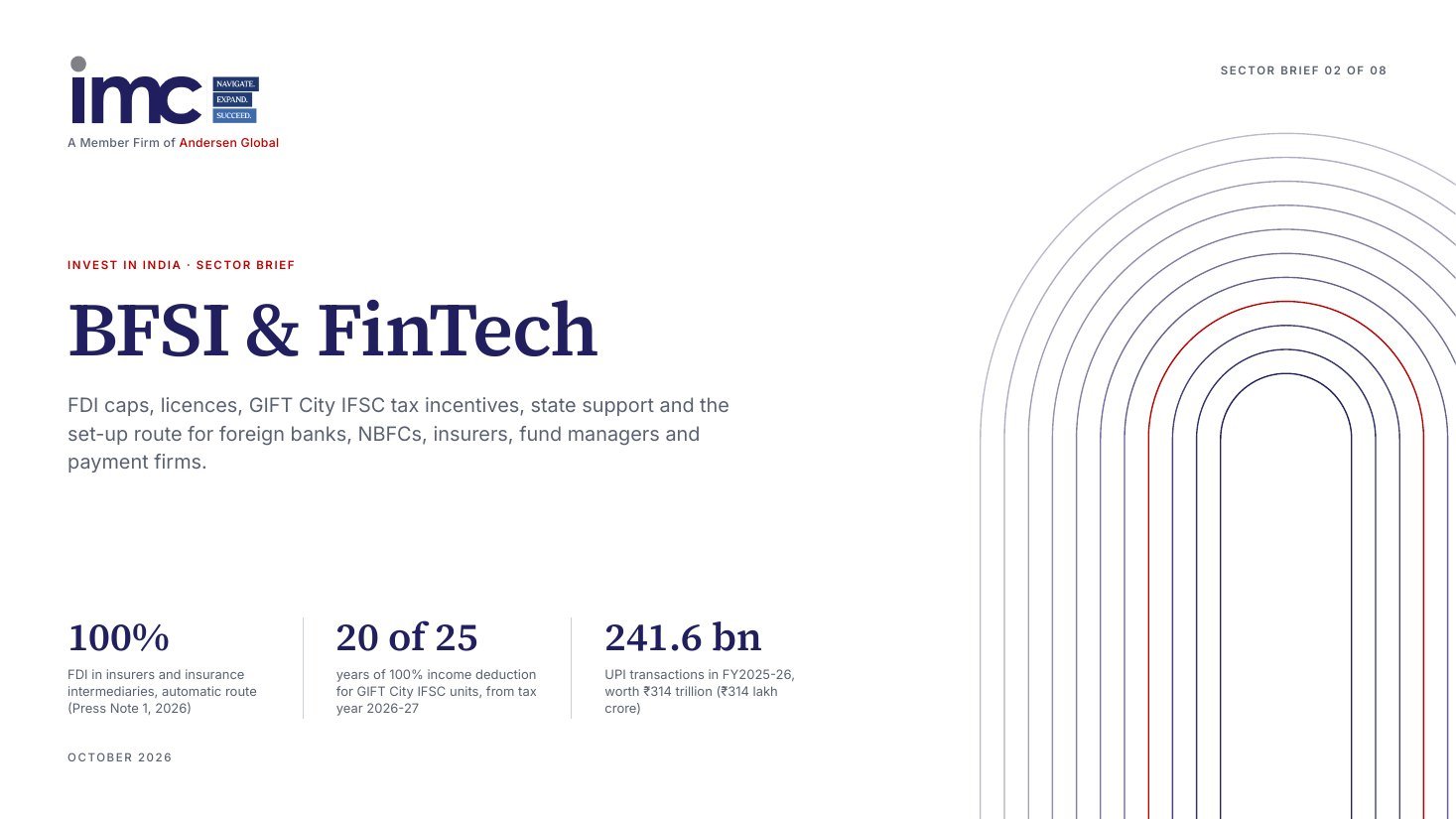
Most financial services now allow 100% foreign ownership, including insurers from May 2026, while banks stay capped. Every activity needs its own licence, and the core choice is between a GIFT City IFSC unit, a licensed onshore entity, or both.
In this brief
Everything in this sector brief
11 pages, from the market case to the set-up roadmap and every incentive with its status.
Banking, financial services and fintech
Most financial services now allow 100% foreign ownership, including insurers from May 2026, while banks stay capped. Every activity needs its own licence, and the core choice is between a GIFT City IFSC unit, a licensed onshore entity, or both.
ReadRecent foreign investments in Indian finance
Japanese, Gulf and US investors are taking large stakes in Indian lenders. Foreign M&A into India's financial sector totalled USD 11.7 bn in 2025, according to Grant Thornton data reported by Reuters. Amounts are as reported.
ReadFDI rules for banking, insurance and finance
Most financial services allow 100% foreign ownership; banks stay capped. Caps come from the Consolidated FDI Policy 2020 as amended by later Press Notes. Financial activities not regulated by a financial-sector regulator need government approval.
ReadRegulators and registrations for financial firms
Each financial activity needs its own licence before business starts. Clearing the FDI cap does not license the business: each activity needs registration or authorisation from its regulator, and most carry a minimum capital.
ReadCentral incentives for financial services
GIFT City's International Financial Services Centre is the main central incentive for financial services: a 20-year income deduction and a lower MAT. The 2026 amending Act added fund and FII exemptions. Status as of 1 October 2026.
ReadState incentives for finance and fintech
Gujarat's GIFT City package is the main state incentive for finance. Gujarat supports IFSC units through its IT/ITeS policy and stamp duty relief. Tamil Nadu's fintech policy ran to 31 December 2025; Chennai's Fintech City offers dedicated space.
ReadTax and zones for financial firms
GIFT City pairs its tax holiday with exemptions on trades, GST and leasing. These measures sit on top of India's general corporate tax rules, under which a foreign-owned company can pay 25.168% and a branch 36.40–38.22%. Each exemption carries conditions and reporting.
ReadSet-up roadmap for financial firms
Two routes in: a GIFT City IFSC unit or a licensed onshore entity. A foreign entrant can serve offshore clients from an IFSC unit, Indian customers through a regulated onshore entity, or both. Licences come before commencement.
ReadWhat to watch in Indian financial services
Ownership tests, licence capital and data rules drive compliance risk for foreign financial firms in India. These are the watch-outs the sources flag, with the pitfalls that follow from the rules on the other pages.
ReadRecent changes in Indian financial services rules
What changed since 2025 for foreign banks, NBFCs, insurers, payment firms and funds in India, from RBI's payment aggregator directions in September 2025 to the fund and FII tax changes of August 2026. Status as of 1 October 2026.
ReadSources for the BFSI and fintech guide
The full reference list for this sector guide, as cited in the BFSI & FinTech sector brief. Statuses are as of 1 October 2026. Entries marked secondary are press or adviser summaries rather than primary texts.
ReadUpdates
Recent changes
- medium impact
- low impact
- high impact
- high impact
- medium impact
Planning your move into India?
Talk to IMC about your entry structure, approvals, incentives, tax and the first year of compliance.